Introduction: When Was the Last Time You Thought About Your Battery?
Most of us don’t give the battery a second thought — until the car won’t start. It happens at the worst times: a cold January morning, a parking lot far from home, or right before a long road trip. And yet, battery failure is one of the most common and preventable causes of roadside breakdowns.
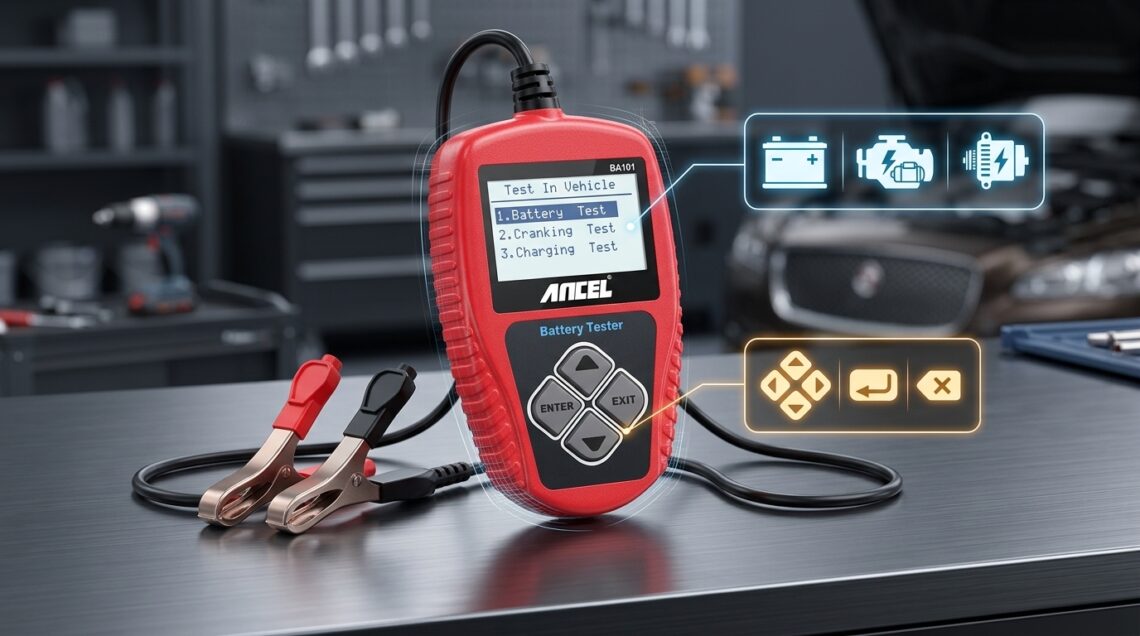
The challenge is that modern batteries don’t always give obvious warning signs. One day they seem fine; the next, they’re dead. That’s where a tool like the ANCEL BA101 Battery Tester comes in. Designed for everyday vehicle owners and automotive enthusiasts alike, it’s built to take the guesswork out of battery health monitoring — without requiring you to be a trained mechanic.
This article walks you through what the ANCEL BA101 does, how it works, who might benefit from it, and what you should know before adding it to your toolkit.
What the ANCEL BA101 Actually Does
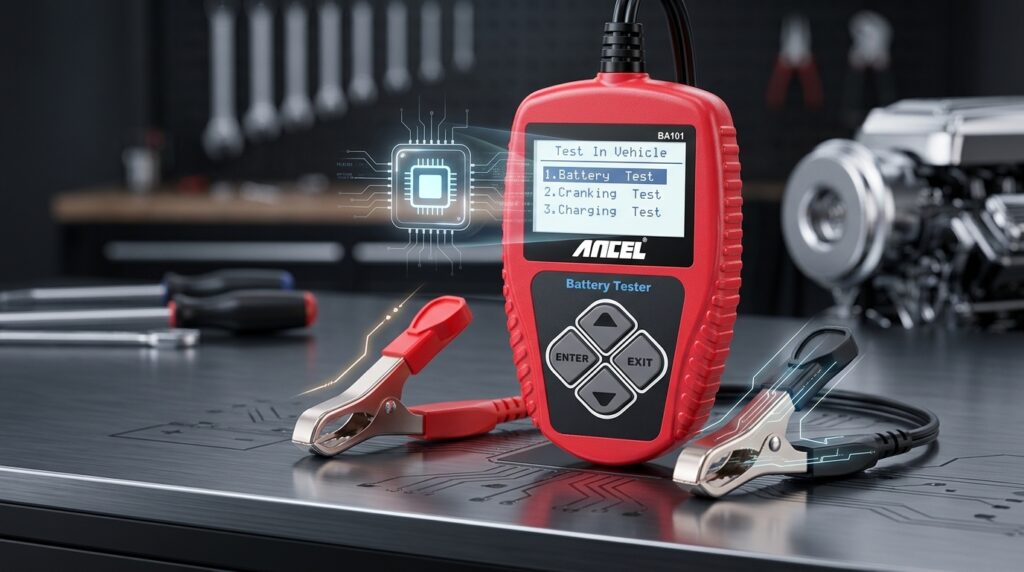
At its core, the ANCEL BA101 is a digital diagnostic device that assesses the condition of a 12V lead-acid battery and evaluates the performance of a vehicle’s charging and cranking systems. Rather than relying on simple voltage readings (which can be misleading), it uses Cold Cranking Amps (CCA) as its primary measurement standard.
CCA refers to the battery’s ability to deliver power at low temperatures — a critical indicator of real-world starting capability. The BA101 supports a CCA range of 100 to 2000, which means it covers everything from compact car batteries to heavy-duty truck and marine batteries.
Beyond battery health, it also analyzes:
- The alternator/charging system — checking whether it’s supplying adequate voltage while the engine runs
- The cranking system — evaluating how well the starter draws power from the battery during ignition
- Battery registration — compatible with certain battery types that require registration after replacement
These three checks together give a fairly complete picture of the electrical health of a vehicle.
Key Features Worth Understanding
Wide CCA Range
The 100–2000 CCA range is one of the more notable aspects of this device. Many budget testers cap at 1000 CCA, which limits their usefulness on larger vehicles. The BA101’s extended range makes it applicable to passenger cars, SUVs, pickup trucks, RVs, boats, and marine engines — essentially any 12-volt system.
Multiple Battery Standard Support
Different markets and manufacturers use different battery rating standards. The BA101 supports several of them, including CCA, CA (Cranking Amps), MCA (Marine Cranking Amps), JIS (Japanese Industrial Standard), DIN (German standard), IEC, and EN. This flexibility is particularly valuable for those working on imported vehicles or marine applications where battery specifications may differ from North American norms.
Digital LCD Display
The device uses a digital LCD screen to display results, which makes readings easier to interpret than analog needle gauges. Results are typically shown alongside a status indicator, so you can quickly understand whether a battery is in good condition, needs charging, should be replaced, or whether the alternator is functioning correctly.
Battery Type Compatibility
The BA101 is designed to work with common 12V battery chemistries including flooded, AGM (Absorbent Glass Mat), GEL, and EFB (Enhanced Flooded Battery) types. This range of compatibility is increasingly important as AGM and EFB batteries have become more common in modern stop-start vehicles.
Compact and Portable Design
The tool is handheld and relatively lightweight, making it easy to carry in a glove box, toolbox, or garage shelf. You don’t need a power source — it draws what it needs from the battery being tested.
Clamp-Based Connection
Testing is done by clamping the device’s leads directly to the battery terminals. The process is straightforward and doesn’t require engine disassembly or advanced mechanical knowledge.
How the ANCEL BA101 Can Be Used
Routine Home Garage Checks
One of the most practical uses is as a periodic health check for your own vehicles. Running a test once a month or before seasonal changes (particularly before winter, when battery performance typically drops) can help you catch problems before they become emergencies.
If a battery is showing declining capacity — say, it drops from 80% health to 60% over a few months — that’s a cue to start shopping for a replacement rather than waiting for a surprise failure.
Pre-Trip Inspections
Before a long drive, camping trip, or any journey where you’ll be far from assistance, a quick battery check can add peace of mind. This is especially relevant for RV owners, who often run additional electrical loads (refrigerators, lighting, entertainment systems) and need confidence that their battery is up to the task.
Marine and Boat Applications
Boats present unique battery challenges. Batteries sit unused for months during off-season storage, and the marine environment accelerates corrosion. The BA101’s MCA (Marine Cranking Amps) support makes it specifically applicable to this context — helpful for checking a boat battery at the start of the season or before heading out on the water.
Fleet and Small Business Use
For someone managing a small fleet of vehicles — delivery vans, company cars, or work trucks — the BA101 offers an inexpensive way to run basic electrical diagnostics without sending each vehicle to a shop. It won’t replace a full diagnostic scan, but it can identify battery-related issues that are otherwise easy to overlook.
Alternator Troubleshooting
A common vehicle problem is an alternator that’s undercharging or overcharging the battery. Both can damage the battery over time. The BA101’s charging system test checks whether the alternator is operating within acceptable voltage parameters while the engine is running — a useful starting point when diagnosing unexplained battery drain or electrical irregularities.
Post-Battery Replacement Confirmation
After installing a new battery, it’s good practice to verify the alternator is properly charging it. The BA101 allows you to do this quickly without additional equipment.
Who Might Find This Tool Useful
This kind of device tends to be most valuable for:
- DIY vehicle owners who prefer to handle basic maintenance themselves and want to reduce unnecessary trips to the shop
- RV and camper owners who rely heavily on battery power and spend time in remote areas
- Boat owners managing batteries across seasonal storage cycles
- Used car buyers looking to assess a vehicle’s electrical condition before purchase
- Small garage mechanics or hobbyists working on multiple vehicles
- Anyone with an aging vehicle where battery health is a reasonable concern
It’s worth noting that this tool is not a substitute for a professional-grade battery analyzer. Automotive technicians and larger repair shops typically use more sophisticated equipment with advanced reporting capabilities. The BA101 is positioned as an accessible, practical tool for non-professional use — though it offers features that go beyond what most casual users might expect at its price point.
Important Things to Consider Before Purchasing
Understanding the Limitations
The BA101 is designed for 12-volt systems. If you’re working with 6-volt systems (found in some vintage vehicles) or 24-volt systems (common in heavy commercial trucks and some specialty equipment), this device won’t be applicable.
Battery Must Be Sufficiently Charged
Battery testers of this type generally require the battery to have a minimum charge level to produce accurate results. Testing a deeply discharged battery may give misleading readings. If a battery has gone completely flat, it’s usually best to charge it first, then test.
Results Are Diagnostic, Not Prescriptive
The device will tell you a battery is weak or that the alternator voltage is outside range, but it won’t tell you why. Persistent alternator issues, for example, could stem from wiring problems, a failing voltage regulator, or other root causes that require further investigation.
Learning Curve for New Users
While the device is designed to be user-friendly, first-time users may need to spend a few minutes with the manual to understand how to set the correct battery type and standard before testing. Incorrect settings can lead to inaccurate readings.
Weather and Environment
Like most electronic diagnostic tools, the BA101 is intended for use in reasonable temperature ranges. Extreme cold or heat during testing can affect results, and the device should be stored away from moisture.
How This Category of Tool Compares to Alternatives
Battery testers broadly fall into a few categories:
Simple voltmeters are the most basic option — they measure voltage only. They’re cheap and easy to use but tell you very little about actual battery health. A battery can show 12.6V and still be incapable of starting a car in cold weather.
Load testers apply an artificial load to the battery and measure how voltage holds up under stress. They’re more informative than simple voltmeters but can be bulky and harder to use.
Conductance-based digital testers (the category the BA101 falls into) measure internal resistance and battery conductance to estimate capacity without needing to discharge the battery. This approach is faster, safer, and generally more repeatable. Conductance testers have become the industry standard for this type of use.
Professional battery analyzers used in shops typically offer more detailed reporting, Bluetooth or software integration, and higher accuracy — but they’re priced accordingly and often overkill for home use.
The BA101 occupies a practical middle ground: more informative than a voltmeter, easier to use than a load tester, and significantly more affordable than professional-grade analyzers.
Frequently Asked Questions
Does this work on all car batteries?
It works with 12V batteries using flooded, AGM, GEL, and EFB chemistry. It supports a wide range of CCA ratings from 100 to 2000, covering most passenger vehicles, trucks, RVs, and boats.
Can it test a battery while still in the vehicle?
Yes. This is actually the recommended approach for testing the charging system — the alternator test requires the engine to be running, so the battery stays connected throughout.
How accurate are the results?
Conductance-based testers are generally reliable for assessing relative battery health and identifying batteries that are clearly weak or failing. However, no handheld tester provides laboratory-grade precision. Results should be treated as strong indicators rather than absolute measurements.
Does it need batteries or charging to operate?
No. The device is powered directly by the battery it’s testing — no external power source required.
Can it be used on motorcycles?
It can work on 12V motorcycle batteries, but the CCA rating must fall within the 100–2000 range. Many smaller motorcycle batteries have CCA ratings near the lower end of that range, so it’s worth checking the battery specification first.
What happens after the test?
The screen displays a result with a status — such as “Good,” “Replace,” “Charge and Retest,” etc. — along with the measured voltage and percentage health. The results are not stored or exported; they’re read directly from the display.
Is it compatible with stop-start vehicle batteries?
Yes. EFB batteries, which are commonly used in stop-start systems, are supported.
A Few Practical Tips for Getting Accurate Results
- Always make sure the clamps are firmly secured to clean battery terminals. Corrosion on terminals can interfere with the reading.
- Enter the correct battery standard (CCA, CA, MCA, etc.) before testing — using the wrong standard will give inaccurate results.
- Test the battery when it’s at or near full charge for the most meaningful capacity reading.
- Run the charging system test immediately after driving, when the alternator is actively running.
- If a result seems unexpected, repeat the test to confirm.
Conclusion
Vehicle batteries are the kind of thing most people only think about when something goes wrong — but they don’t have to be. A straightforward tool like the ANCEL BA101 puts basic electrical diagnostics within reach of any vehicle owner, regardless of mechanical background. Whether you’re managing an aging sedan, prepping an RV for a summer trip, or keeping a boat ready for the water, having some visibility into your battery’s condition is simply smart maintenance.
It won’t replace a certified mechanic when things get complicated, but for routine monitoring, pre-trip checks, and early problem detection, it offers real practical value.